

When the most important thing in a workshop is not meant to be shared
A reflection on why real change requires that we give the personal space professional room.
I have a confession:
I don’t particularly enjoy being a participant in workshops.
It may sound paradoxical, given that I facilitate many of them myself. But as a participant, I often feel an inner resistance. The pace is high. The expectation of output is clear. Conversations need to be efficient, points sharp, and the process should preferably lead somewhere concrete. There is rarely space for the unresolved, the slow, or what has not yet found its form.
I know that for many, workshops feel energising; a welcome break and an opportunity to be guided into shared thinking and co-creation. Most workshops are designed precisely to create movement between people.
But recently, I had the opportunity to design a team day where the premise was different.
Standing in change – without knowing what it will look like
I worked with a team in the City of Copenhagen’s Culture and Leisure Administration. They operate in a complex field between political directives, cross-organisational coordination, and daily operations. At the same time, they were facing an upcoming organisational change whose consequences were not yet fully defined.
Relationships within the team are strong. Collaboration is harmonious. There was no need for classic team building or idea generation. The task was rather to strengthen each individual’s ability to stand steadily in a reality where the direction was not yet clear.
This meant that the day was not about deciding, producing, or formulating new shared ambitions. It was about the preconditions for navigating change – personally as well as collectively.
The personal space as a professional workspace
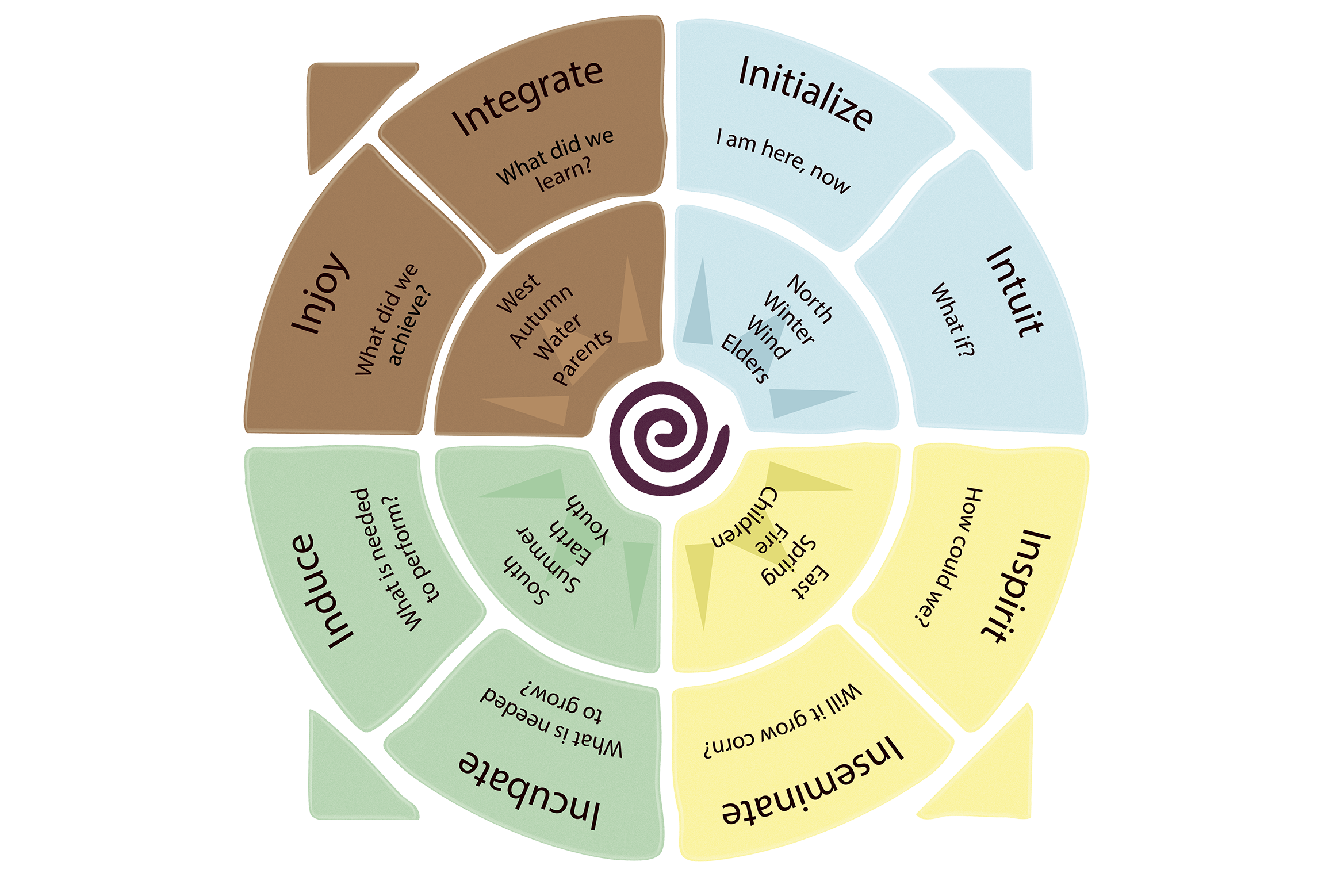
We worked with a few thematic anchors: the seasons as a framework for understanding and regulating personal states; informal leadership as something we can both offer and ask for; and curiosity as a legitimate measure of success when tangible results are delayed.
The themes themselves are well known in change work. What was different was the weighting.
Instead of primarily facilitating shared conversations and collective output, I placed significantly more emphasis on the personal space. Each participant received a personal logbook that followed the structure of the day. It was not intended as documentation. Not something to be handed in or shared. But as a private working tool.
Time was deliberately set aside for individual reflection, writing, and silence. Sharing was possible – but never required.
Silence was allowed to exist. When no one spoke, it was not filled. Pauses were not broken out of nervousness. Gradually, the room was trained to accept that it is legitimate to think something through – or halfway through – before speaking.
It does not only change the pace. It changes the quality of what emerges.
When what is not said continues to work
I was honestly uncertain afterwards.
There were no walls covered in post-its. No collective statements that could be photographed to document “the result.” Many of the insights had remained with the individual.
During the debrief, the organisers of the day shared the team’s overall evaluation – and it became clear that precisely the respect for the individual space had been crucial. Several had felt an initial nervousness at the thought of moving close to personal reflections. But not being pressured to share had created psychological safety.
What was not spoken aloud had, in fact, continued to work.
It reaffirmed a point I return to again and again: change is not anchored in collective decisions alone. It is anchored in people. And people process first in the personal space before anything can be carried into the group and eventually into the organisation’s shared direction.
Three spaces – one system
In my facilitation, I therefore consciously work with the movement between three levels: the personal space, the group space, and the collective space.
If we skip the personal, we risk decisions becoming superficial or later resisted. If we skip the group, we lose the mirroring and qualification. And if we avoid the collective space, we lack direction and commitment.
Generally, we are skilled at the latter two. The personal space still lacks professional methods.
Perhaps because we still try to separate the personal from the professional, as if the former can be left at the door.
It cannot.
The personal perspective is always present: experiences, emotions, energy, doubt, engagement. The question is not whether it is there – but whether we design our meetings and workshops in a way that gives it legitimate room.
That team day reminded me that some workshops only truly begin to work on Monday morning, when the participant opens their own notebook again and revisits what was never shared out loud.
You can explore some of the themes we worked with during the workshop here:
- DesignWISE – the seasons as a framework for understanding and regulating personal states,
- Leadership Roles – informal leadership as something we can both offer and ask for,
- Learning Mechanism – curiosity as a legitimate measure of success when results are delayed.
SHARE "When the most important thing in a workshop is not meant to be shared" with a friend:
Maybe this would also be interesting for you?
DesignWISE — Introduction Meditation
Experience the DesignWISE introduction meditation — a 13-minute guided journey to realign your inner compass and explore your next step.
DesignWISE — Introduction Meditation

Fashion Dreaming – voices from fashion’s future
What do the voices of the future fashion industry tell us about a sustainable transformation? The industry dreams together at Copenhagen Fashion Week 2024.
Fashion Dreaming – voices from fashion’s future

The Right Educations for the Right Students
Tailored graduate profiles strengthen program relevance and create a shared goal for instructors at KEA Design through a co-creative process
The Right Educations for the Right Students

A Call for Slower Creativity
Break up with the sprint culture in design and innovation and start creating lasting cultural change and boost well-being in your organization by embracing slower creativity.
A Call for Slower Creativity


